







There are jewels we admire for their beauty. Others attract us for the quality of their gems, the perfection of their craftsmanship, or the uniqueness of their design. However, when we talk about an engagement ring, something special happens.
Although the gemstone often captures much of our attention, the true star is frequently the design itself. From the classic solitaire to the rosette, the triplet, or the Toi et Moi, There are different types of engagement rings, each with a particular way of expressing beauty.
Even before knowing the story behind a piece, its lines, proportions, and composition are already conveying something.
Perhaps that's why two people can fall in love with completely different rings. Not because one is better than the other, but because each design has a distinct way of expressing beauty.
In fine jewelry, designing is not simply about deciding where to place a stone or what metal to use. Every choice modifies the character of the piece.
A ring can be understated or expressive. Architectural or organic. Classic or unexpected. Delicate or bold.
And just as a building, a work of art or a design object conveys certain sensations, a ring also has its own visual language.
That's why, often, the choice of a design says as much about the wearer as the gem that occupies its center.
Few jewelry styles are as instantly recognizable as the solitaire. Its strength lies precisely in its simplicity. A single gemstone becomes the absolute center of the composition, and the entire design works to complement it.
It does not require elaborate decorative elements or complex structures.
It's a design that conveys clarity, balance, and confidence in the gem's beauty. Perhaps that's why it remains one of the great classics of jewelry. Because sometimes less means so much more.
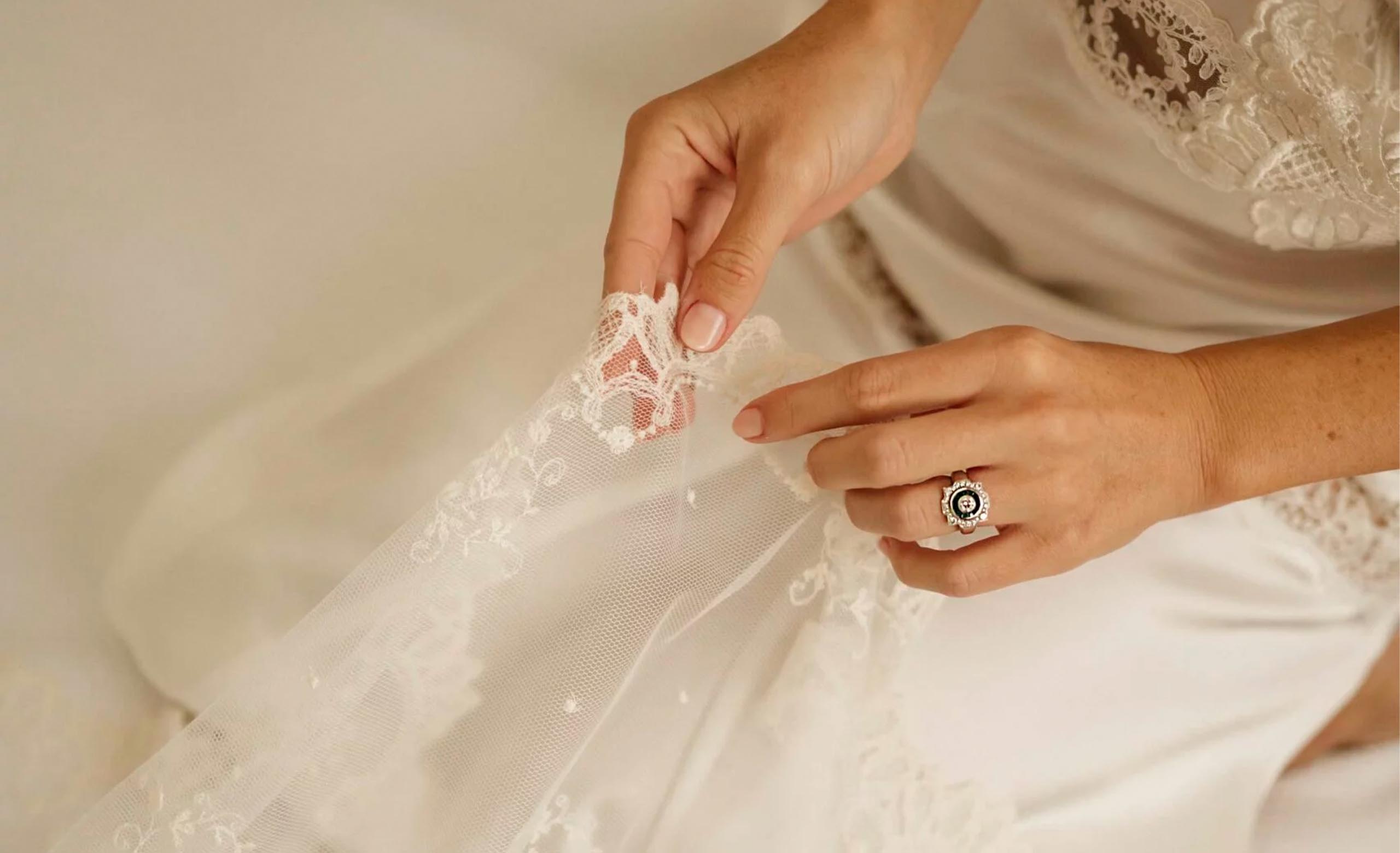
While a solitaire focuses all attention on a single stone, a rosette creates beauty through its arrangement. A central gem appears surrounded by other stones that amplify its presence and brilliance.
It is a composition that we find in different eras of jewelry history and that has demonstrated an extraordinary ability to reinvent itself.
It can be classic or contemporary, delicate or spectacular, depending on the proportions, the chosen gemstones, and the setting. The rosette reminds us that some jewelry pieces are not built around a single focal point, but rather on the harmony between all their elements.
There is something particularly satisfying about certain designs that seem to strike a perfect balance. The three-piece suite belongs to that category.
Three stones create a symmetrical and visually stable composition. The eye naturally moves between them and perceives a sense of continuity.
It can take many different configurations: three diamonds, a central stone flanked by two colored gems, or even combinations of different cuts. The interesting thing is that the spotlight is shared.
There is no single dominant stone, but a conversation between several.
Among the most unique typologies, the ring known as Toi et Moi ("you and I").
Its main characteristic is the presence of two stones facing each other.
From a design perspective, it's fascinating because it introduces a visual relationship between the two gems. Neither occupies exactly the same role as the other, and yet they form a unified whole.
Two different colors, two different sizes, or even two stones of completely different natures can coexist within a single piece. Few designs manage to convey so much personality with such a seemingly simple structure.
Some rings seem to be inspired by architecture. Their lines are precise, geometric, and carefully constructed. Volumes, steps, symmetries, and proportions take on special prominence.
These are pieces that usually convey a sense of solidity, order, and modernity.
In these works, beauty stems not only from the stones themselves, but also from the way the structure supports and organizes the entire composition. As in great buildings, each element seems to occupy precisely its rightful place.
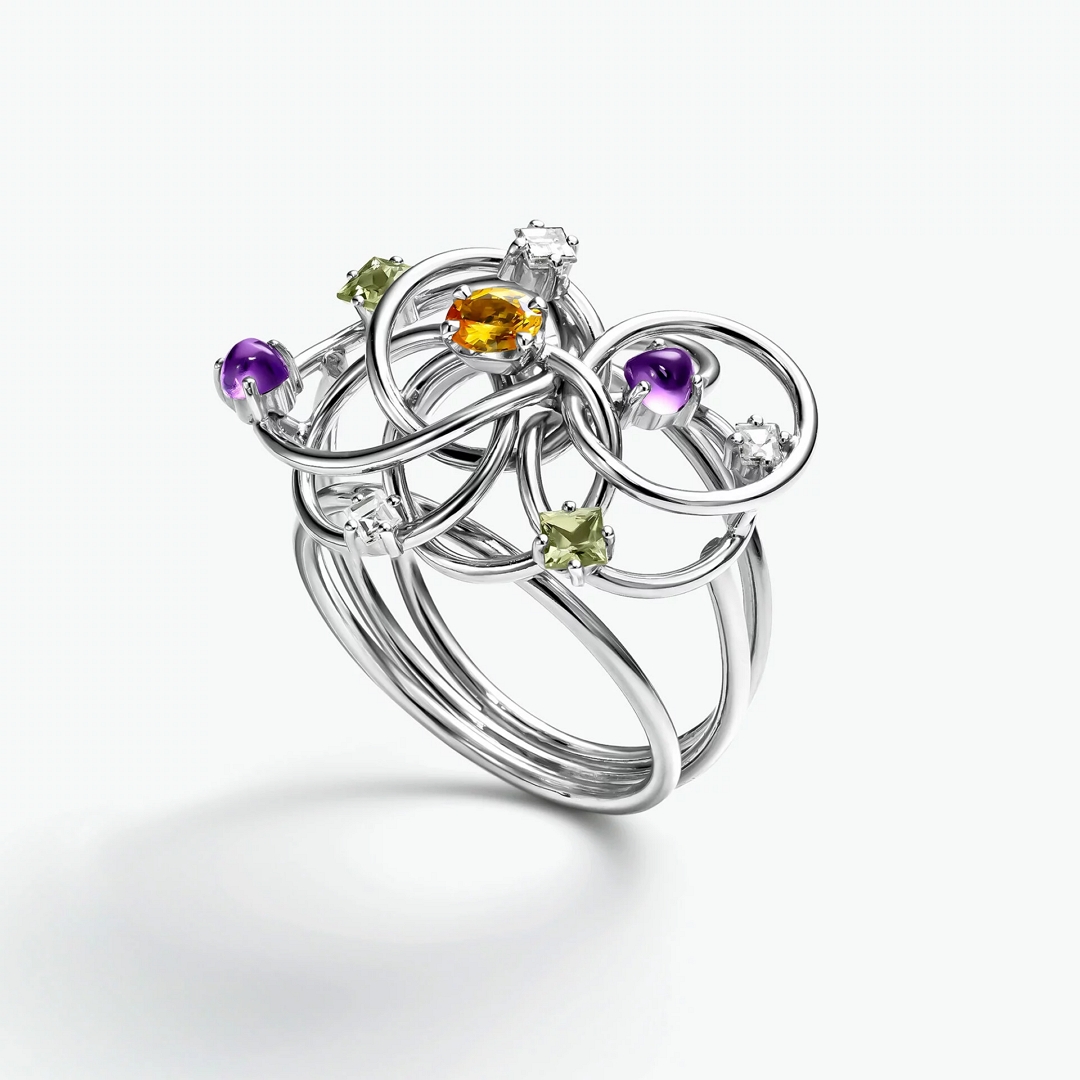
In contrast to geometric precision, we find another way of understanding design. Organic lines seek inspiration in nature, movement, and the forms we find in our environment.
Soft curves, fluid volumes, and less rigid compositions allow for the creation of rings that appear to grow naturally around the gemstone. These designs convey lightness, movement, and a particularly emotional sensitivity.
And that is precisely why they are so attractive to those looking for a less conventional piece of jewelry.
For decades, the diamond has held a privileged position in engagement rings.
However, colored stones have opened up an immense creative universe.
A sapphire, an emerald, a ruby, or an aquamarine not only add color; they also alter how we perceive the whole. The same design can look completely different depending on the gemstone chosen.
Sometimes it is precisely the color that makes a piece of jewelry unique and deeply personal.
When someone falls in love with a ring, it's rarely for purely technical reasons. There's something more difficult to explain. A particular proportion. A curve. A way of playing with light. The balance between metal and gemstone. A feeling that arises upon first seeing it.
That's why two people can choose completely different designs and yet be making the same decision: to find a piece of jewelry that represents them.
Because an engagement ring doesn't just speak through its materials.
It speaks through its lines, its volumes, and its proportions.
And when design is able to reflect a story, a personality, or a way of understanding beauty, something extraordinary happens.
The ring begins to tell a story even before we utter a single word.
At Sara Benavente High Jewelry, each creation stems from this search for identity, where design, gemstones, and personal history find their own expression. A way of understanding the unique engagement rings as pieces designed to represent what makes each story unique.
Su cesta de compra está vacía. Le invitamos a descubrir nuestros productos en la tienda.